
.png)
What does it take to build a brand that delivers—strategically, operationally, and culturally? Episode 52 of the Ninety Podcast explores how leadership teams can create brands that scale while staying grounded in purpose and clarity.
A brand is not a logo or a campaign. It is how an organization builds trust through consistent behavior over time.
The Brand as an Operating System
Organizations often approach branding as a one-time event. They focus on the visual layer while neglecting the operational core. In truth, a brand reflects how a business works. It mirrors the systems, standards, and choices made at every level.
Trust grows when promises are made and kept. A brand earns equity through repetition of aligned decisions and reliable delivery.
A Practical Framework for Brand Building
The conversation outlines a four-phase model for building brands that scale with purpose and alignment:
1. Brand Discovery
This phase uncovers how the brand is perceived, what customers expect, and where disconnects exist. Interviews, brand audits, and competitive analysis reveal the truth of the current state. Decisions can only improve when based on accurate input.
2. Brand Foundation
With clear inputs, the next step is to define five core elements:
- Brand Purpose – The difference you make beyond making money. (e.g., "To empower every team to do great work.")
- Brand Position – What you want to be known for in the customer's mind. (e.g., "The leader in data-informed decision making.")
- Brand Promise – The overarching benefit you deliver. (e.g., "Turn complexity into clarity.")
- Brand Pillars – The key differentiators that give you the right to win.
- Brand Personality – How your brand looks, sounds, and feels.
These elements provide direction. They do not change frequently. They form the basis for every decision moving forward.
3. Brand Expression
This phase translates the foundation into visible outputs: name, messaging, visual identity, and content. These elements should reflect the defined position and reinforce the brand’s purpose and promise.
Customers form impressions based on every point of contact. Consistency matters. It reduces confusion and builds recognition.
4. Brand Activation
Brand activation ensures the brand lives beyond the strategy deck. It shows up in hiring, onboarding, customer service, sales materials, and content. Every message, channel, and team decision reflects—or dilutes—the brand. This includes not only how teams communicate internally, but also how the brand engages externally through marketing campaigns, sales conversations, support documentation, and thought leadership content. Activation depends on consistency across touch points, not perfection. Aligned actions repeated over time build brand credibility.
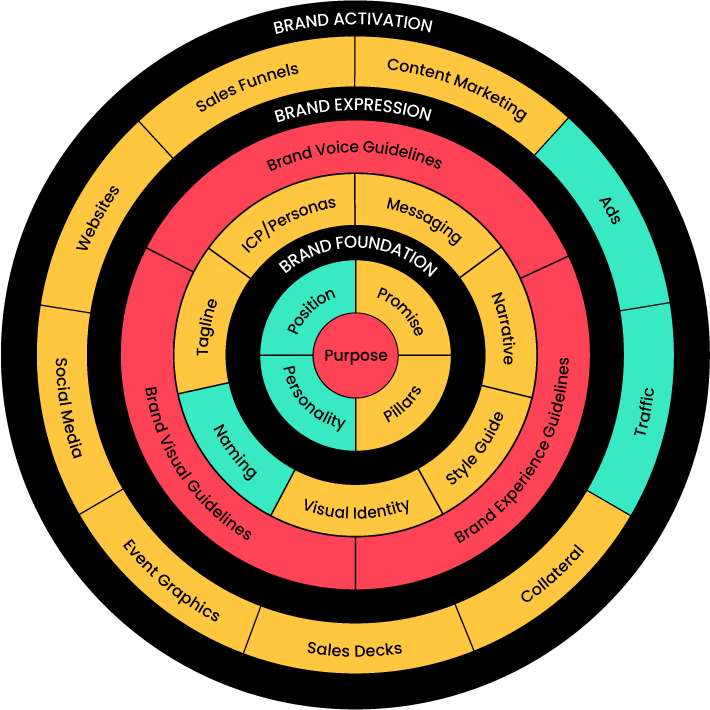
Purpose Informs Strategy
Purpose acts as a filter. It defines what the organization will pursue and what it will decline. A clear purpose simplifies decision-making and sharpens focus.
When teams understand why the organization exists, they make better decisions. They focus on outcomes that align with that purpose.
For Leadership Teams
When a brand lacks clarity, the issue often starts at the top. Without alignment at the leadership level, the brand drifts. Teams receive mixed messages. Customers feel the effects.
A strong brand reflects operational discipline and clear intent. It is built by organizations that commit to consistency over time.
Listen to the full episode:
Episode 52 of the Ninety Podcast with Mark Abbott features this full conversation. Find the full episode here.


.png)


.png)

%20-%20Made%20with%20PosterMyWall.jpg)

.png)


.png)



.png)

.png)



.png)
.png)
.png)

.png)



.png)


.png)



.png)
.png)
.png)

.png)
.png)

.png)

.png)


.png)
.png)

.png)
.png)
.png)
.png)