

If your marketing feels unfocused, or if your leads aren’t converting as they should, the problem may not be your tactics. It might be your aim.
A great marketing strategy doesn’t start with a campaign. It starts with clarity about who you’re trying to reach. That’s where ICPs come in.
Whether you’ve never heard of an ICP or just haven’t taken the time to define yours, this guide will give you the full picture. What it means, why it matters, and how to build one that sharpens your strategy, strengthens your sales, and grows your brand the right way.
Let’s get into it.
What Does ICP Mean? (And Why It’s Critical)
ICP stands for Ideal Customer Profile. It’s a detailed description of the kind of company that gets the most value from your product or service and brings the most value back to your business.
In simple terms, it answers the question: Who is our best customer?
Not just who could use what you sell. But who should.
ICPs are especially important in B2B, where you’re not selling to an individual, but to an entire organization. A strong ICP includes firmographic details like industry, size, revenue, and location—traits that describe the company, not just the people inside it.
When you know who your ideal customer is, you can:
- Create messaging that speaks to their exact needs
- Target your marketing spend more effectively
- Equip your sales team with stronger talking points
- Improve customer retention and satisfaction
It’s one of the most practical things you can do to improve your marketing strategy—and it often gets overlooked.
Why ICPs Are the Foundation of Better Marketing
The best marketing is focused. But focus is impossible if you’re unclear on who you’re targeting.
Too many companies try to appeal to everyone. The result? Messaging that’s broad, generic, and forgettable.
When you define your ICP, you give your marketing a bullseye.
Let’s say you sell workflow software. Without an ICP, your messaging might target “any business looking to be more efficient.” That sounds fine, but it speaks to no one. With an ICP—say, mid-size accounting firms with 10–50 employees in North America—your messaging gets sharper, more relevant, and more persuasive.
Focused messaging drives better results. We’ve seen companies increase qualified leads significantly—without raising ad spend—just by focusing their campaigns around a well-defined ICP.
Knowing your ICP helps you stop guessing and start resonating.
How to Build an ICP That Improves Your Strategy
Creating an Ideal Customer Profile isn’t complicated—but it does require some thought. Here’s how to build one that helps your marketing team move with clarity and purpose:
1. Analyze your best customers
Start by looking at your top 10–20% of current clients. Who brings in the most revenue? Who is easiest to support? Who sticks around?
2. Look for shared traits
What do these customers have in common? Look at:
- Industry
- Company size
- Geography
- Annual revenue
- Tech stack
- Growth stage
3. Dig into the “why”
What pain points do these companies face that your product solves? What specific outcomes do they care about?
4. Align with your internal teams
Talk to sales, support, product, and leadership. Everyone should agree on what a good-fit customer looks like. If they don’t, your strategy will splinter.
5. Document it and use it
Write your ICP information down. Refer to it often. Make sure it’s baked into your marketing, sales, and product decisions—not just sitting in a doc somewhere.
ICPs vs Buyer Personas: What’s the Difference?
ICPs describe companies. Buyer personas describe people.
Here’s a simple way to think about it:
Your ICP is the type of business you want to work with. Your personas are the key touchpoints inside that business.
You need both.
Say your ICP is:
Tech-enabled logistics companies with $5M–$20M in annual revenue
Inside that company, you might be talking to:
- A VP of Operations (motivated by efficiency)
- A CFO (focused on cost)
- A COO (focused on scalability)
The ICP defines the “where.” The persona defines the “who.” Don’t skip either.
To learn more about the differences between ICPs and buyer personas, check out this resource.
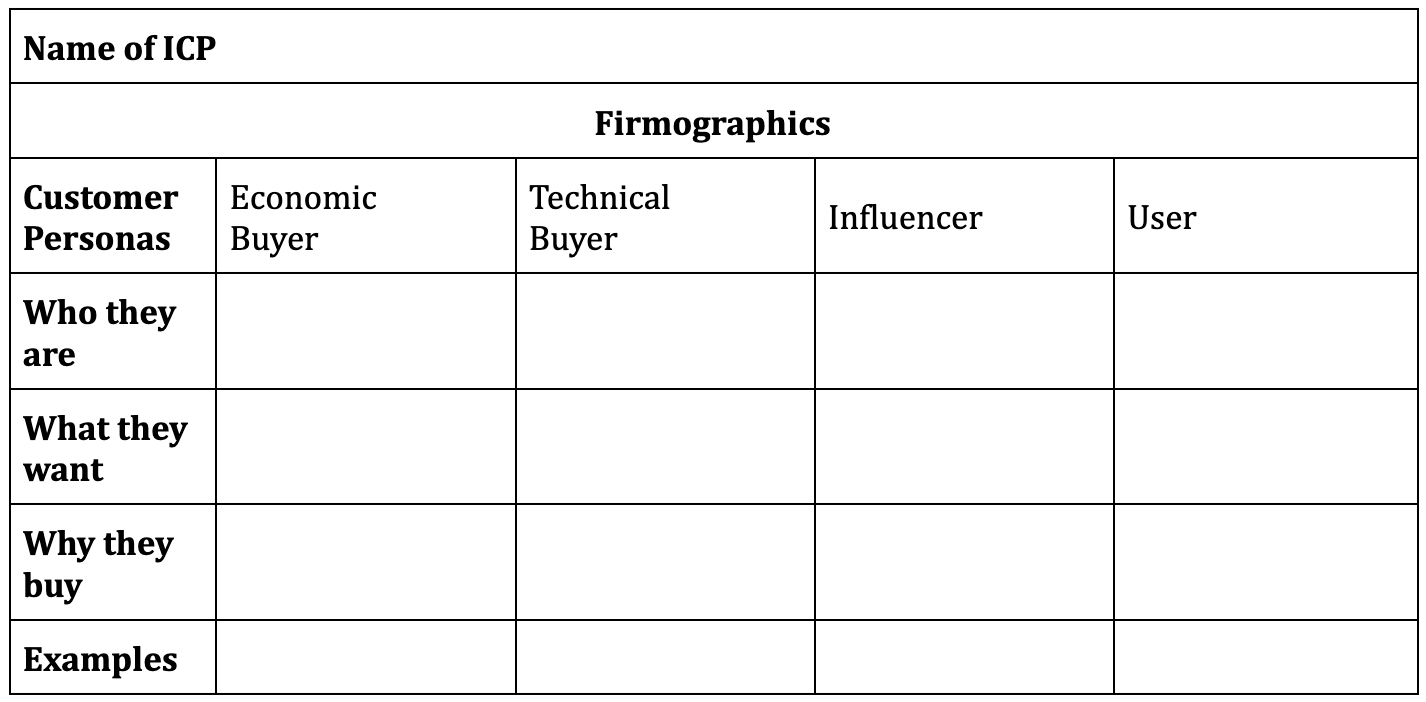
Real-World ICP Examples (Across Industries)
Sometimes it helps to see real-world examples to understand how this works. Here are three ideal customer profile examples that illustrate how specific and strategic these profiles should be:
SaaS
ICP: B2B software companies with 50–200 employees using Salesforce and struggling with pipeline visibility.
Why it works: There’s a clear need, existing budget, and a known tech ecosystem you can integrate with.
Healthcare
ICP: Multi-location dental practices with in-house billing teams.
Why it works: They need operational systems that scale and have a clear pain point in managing claims.
Manufacturing
ICP: U.S.-based auto parts distributors serving regional chains of repair shops.
Why it works: Recurring, high-volume operations that benefit from streamlined inventory management.
Notice how each profile narrows the focus and opens the way to a better, more effective strategy.
What Happens When You Get Your ICP Right
Companies that align their marketing to a strong ICP see results quickly. You’ll notice:
- Shorter sales cycles
- Better fit leads
- Lower churn
- More effective targeting
- Stronger brand alignment across teams
When companies spread their efforts across too many verticals, it waters down the impact. Focusing on a well-defined ICP often leads to better ROI and shorter sales cycles.
Common Mistakes to Avoid
If your ICP isn’t helping your strategy, you may be falling into one of these traps:
- It’s too broad. “Small businesses that want to grow” isn’t an ICP. It’s a wish list. Narrow it down.
- It’s based on opinion, not data. Use real customer metrics, not just gut feelings.
- It’s not documented. If it’s not written down and accessible, your team won’t use it.
- It hasn’t been updated. Your business evolves. Your ICPs should, too.
A good test: If your sales team can’t describe each ICP in one sentence, you don’t have a clear one yet.
Final Thoughts
Defining your ICPs is one of the simplest, highest-impact moves you can make.
It doesn’t require fancy tools. It doesn’t take a massive budget. It just takes discipline to focus on who you serve best and build around them.
Because great marketing doesn’t speak to everyone. It speaks to the right people.
And when your strategy is built on that kind of clarity, growth follows.
Need help building a clear, focused ICP and crafting messaging that speaks to it?
Let’s talk. At Backstory, we help brands define their ideal customer, articulate their value, and build marketing strategies that scale.


.png)


.png)

%20-%20Made%20with%20PosterMyWall.jpg)
.png)


.png)



.png)

.png)



.png)
.png)
.png)

.png)

.png)


.png)


.png)
.png)
.png)

.png)
.png)

.png)

.png)


.png)
.png)

.png)
.png)
.png)
.png)